Back-To-Land and Black Power-Led Farmers Markets 1970-1980
Back-To-Landers: Defined as an agrarian movement that focuses on small scaled farming, local community, and economic self sufficiency to combat some or all forms of industrial systems.
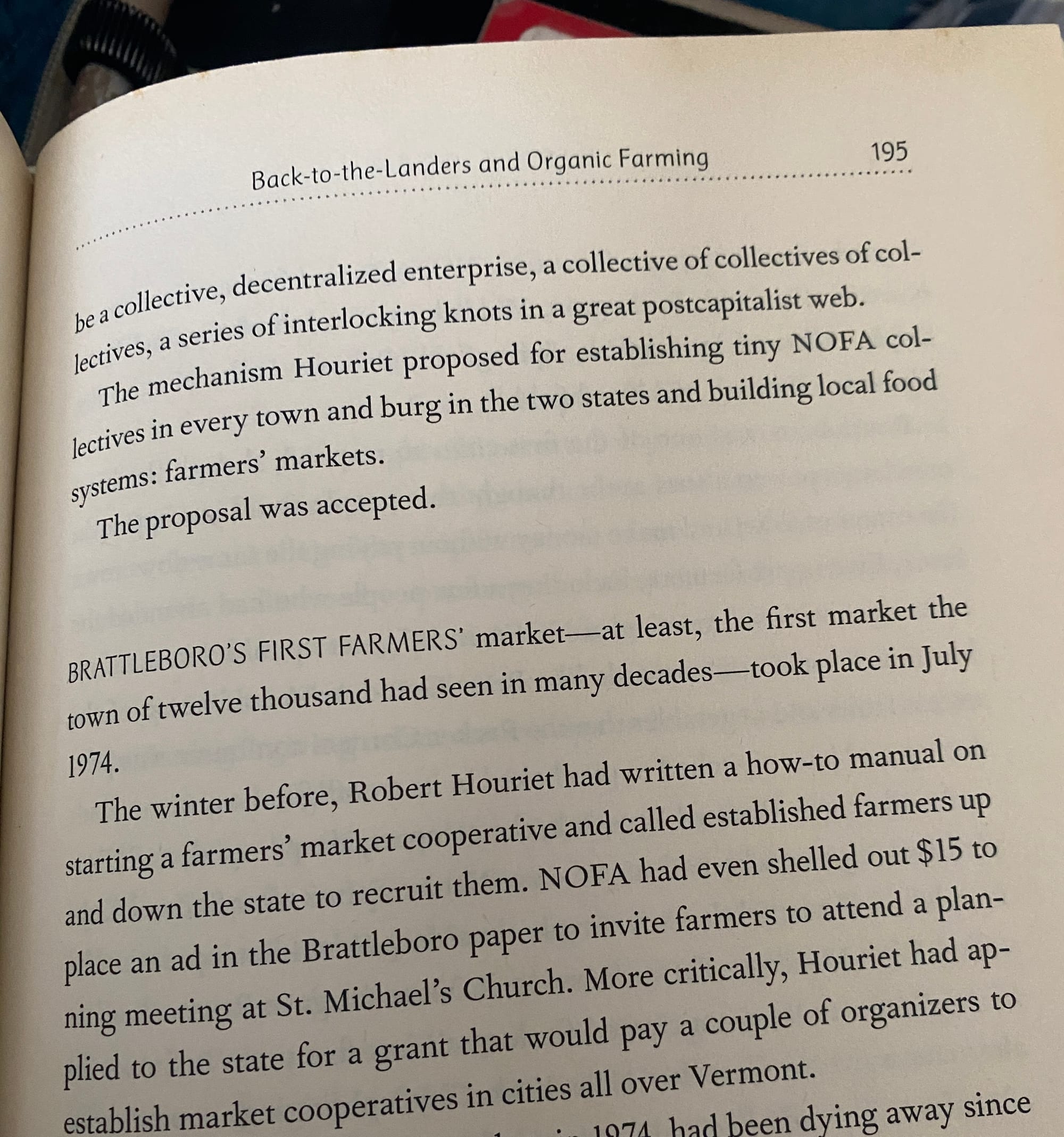
In the U.S., the 1920s-30s saw one such era, post-WW2 had another small, more suburban one, and then a much larger and recorded time in the 1960s/early 1970s. This market history will focus on the most recent, although we cannot without crediting earlier leaders including Scott and Helen Nearing, J.I and Robert Rodale, Robert Borsodi, and Louis Bromfield, the Diggers (both versions!), among others. All have fascinating histories written about them and books authored by them to discover for anyone interested.
Black Power: Defined as a resistance to white supremacy, focused on creating new channels of power, economic empowerment and artistic expression for African-Americans through self-help and education.
Black Power also has had many eras, and we cannot talk of the 1960s/1970s food and farming era era without crediting W.E.B. Du Bois, Booker T. Washington, George Washington Carver, Booker T. Whatley, Thomas Campbell, Bobby Seale, Ruth Beckford-Smith among others.
Farmers markets founded by members of these two groups do exist, although fewer of the Black Power leaders chose farmers markets as their method for change. Based on published accounts, many Back-To-Landers of the 1960s were white activists who had worked on human rights or anti-war work and moved on to more localized issues by 1970 or so. For example, when I asked Athens Farmers Market farmer Ann Fugate why she had ended up farming in a rural county of Ohio she said, "after McGovern lost (the presidential election of 1972), I decided to move a mile out past the last sidewalk." Even though her national activism seemed to have ebbed, her passion for community work didn't, evidenced by her decades of leadership in Athens. Maybe more importantly, many decided to live the "personal is political" as the saying went, and many of the early farmers market founders were dedicated to reducing poisons in our water and on land by championing organic methods.
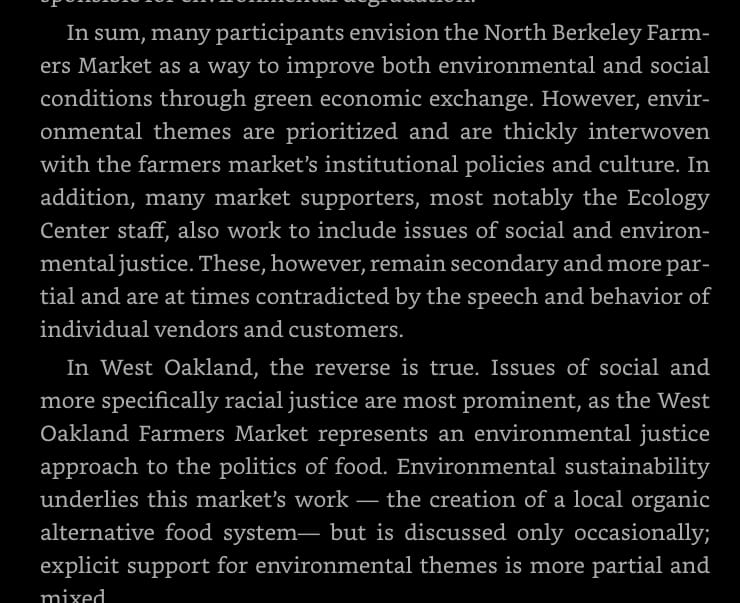
In terms of Black Power, as Alison Hope Alkon's groundbreaking book Black, White and Green; Farmers Markets, Race, and the Green Economy points out, when you compare and contrast the sustainability and social justice movements (as she does by examining two neighboring markets- the North Berkeley Farmers Market and the West Oakland Farmers Market), these market founders have quite different design and missions and as a result, their vendor and shopping bases contrast from one another.
So although vital to include in this history, it is possible there may be limited written histories linking them directly to many farmers markets. That may mean that we have to rely on anecdotal oral histories to explain more about the motivations behind the rise of green capitalism and justice work, rather than histories of specific markets in order to make sure these early leaders are known. I saw this in action recently when I was at the inaugural SOWTH conference in Atlanta, gathering information from founders while there. A young beekeeper asked me what the term back-to-landers meant, as he hadn't heard it before. That suggests an opportunity for this history to fill in some gaps about the people and influences to whom we all owe a debt.
It was also made clear during the introduction of the Anti-Racist Farmers Market Toolkit that the need for and the work of earlier Black Power leaders was not widely known, leading to a sense that this idea of a Toolkit for farmers markets to level up to system change justice work was novel or somehow random. For example, a few organizers know the Black Panther's Free Food Program of Oakland California and its impact in the U.S., but fewer know Whatley's work of CSA and U Pick development, or even the work and challenges that face present day entities such as the Federation of Southern Cooperatives, among many others.
So while this meandering around long ago histories may be maddening to some, it seems vital to me. The multiple strands that contribute to the growth of what is arguably the most important channel in local and regional food system development need to be examined and organized as best they can. If for no other reason, because to move forward without knowing the past may limit our work in the future.