Why Farmers Markets Close
shout out to Gary Stephenson, Larry Lev and Linda Brewer
Over the years, a few books and reports have become staples of my research and understanding of the modern farmers market. This is one short list I have created of books that relate to direct-to-consumer marketing, and farmers market design and management. One of the key books I use was written by (retired) Oregon State Extension’s Gary Stephenson and is titled “Farmers' Markets: Success, Failure, and Management Ecology”
This book examines the characteristics of how markets are managed and the correlated outcomes of those management types. It is my understanding that the book grew from an earlier paper that, whenever market folks were gathered, was a HUGE topic: “When Things Don't Work: Some Insights into Why Farmers' Markets Close” with Larry Lev and Linda Brewer.
By looking at the instances when markets didn’t work out, the team was able to separate characteristics that seemed to be universal, including what may appear to be obvious but wasn’t then and, honestly, still isn’t by some market partners:
Those with a high chance of failure had small sizes, high need for products, low administrative revenue, volunteer or low-paid managers, and high manager turnover. (In recent years, I have had conversations with markets that have analyzed that they can have too MANY vendors for a space or their management structure, which I will cover at some point.)
The Stephenson/Lev/Brewer report relied only on Oregon data, so it was too bad that other states’ extension teams didn’t follow up using the same framework and give us a robust national or regional analysis of why markets close. Even so, it is so helpful that even though it just focuses on Oregon, their research is still used regularly by researchers and, indeed, is a significant part of my thesis.
(This team is also well known for creating the first set of tools for open-air farmers markets to measure their real-time impact, such as tracking attendance, with the Rapid Market Assessment, which includes the valuable but often misunderstood Dot Surveys, used too sparingly and usually just for the visitor counting part of it).
When markets close may be one of the few times that the shopping public notices the “man behind the curtain” (sic) so it seems helpful to explore regional and national trends of market closings over the past 50 years as my articles and book are meant to speak to anyone interested in markets as shoppers, as partners, as neighbors in civic renewal.
The national tracking of the number of markets indicates a steady climb in overall numbers, but part of that is a change in what was being counted as a farmers market, and also a tendency to rely on self-reported data which was not always likely.
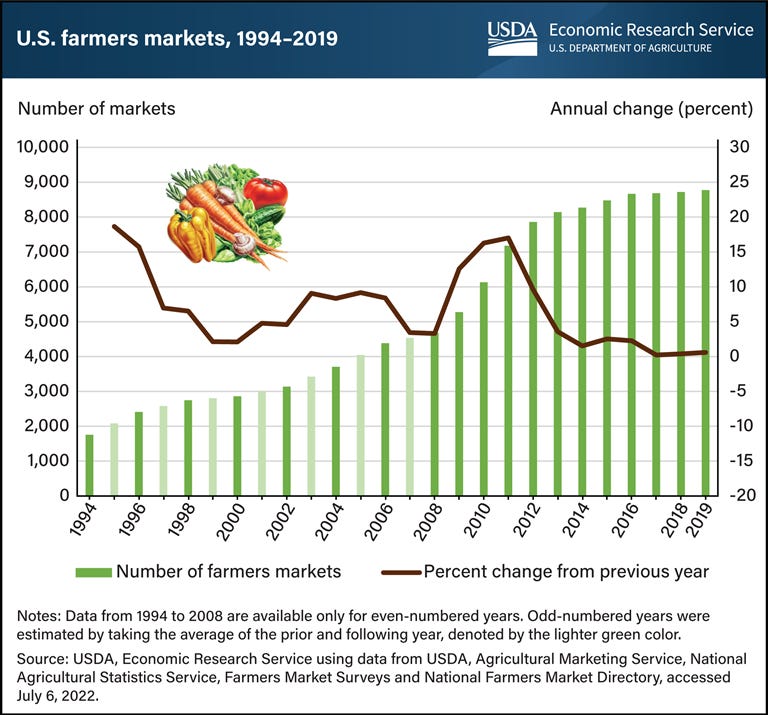
I will also note here that academic reviewers, one of grants and another who focuses on peer-reviewed articles, have both suggested to me directly that farmers markets are “declining” because the number of markets is not rising as quickly as it had in previous decades. I cannot suppress an eye roll at the memory of those emails.
So, how one tracks the closing of farmers markets in terms of uncovering the lessons of this 50-year movement is what I am puzzling. I certainly don’t agree that markets are declining when the number of markets operating today is almost double that of the number of Walmarts currently open in the U.S. (thanks to researchers Bret Shaw and Laura Witzling for uncovering that data!)
and yes with their Sams Clubs blah blah they are are far ahead in total retail outlets and far in the distance with hours operating. I’ll talk in a post soon about how industrial ag and community ag are different arcs and can, therefore, exist simultaneously without one killing the other or becoming the other - look for the “Two Loops” post soon.
Still, that initial piece of data is pretty cool, right?
I think the accounts of markets decline is overstated also because anyone can see markets are diversifying in their goals and structure and deepening their impacts at a single site rather than populating a new one on every corner.
But markets DO close. And why and when they do is important to share. I expect that data will be harder to find than finding those who know their market’s origin story.
So I plan a new survey form on markets that closed to go along with the Brief History survey that remains open for markets to tell me their origins, but I am also wondering if my readers have other ideas for how to find the story of those markets.
If so, share.